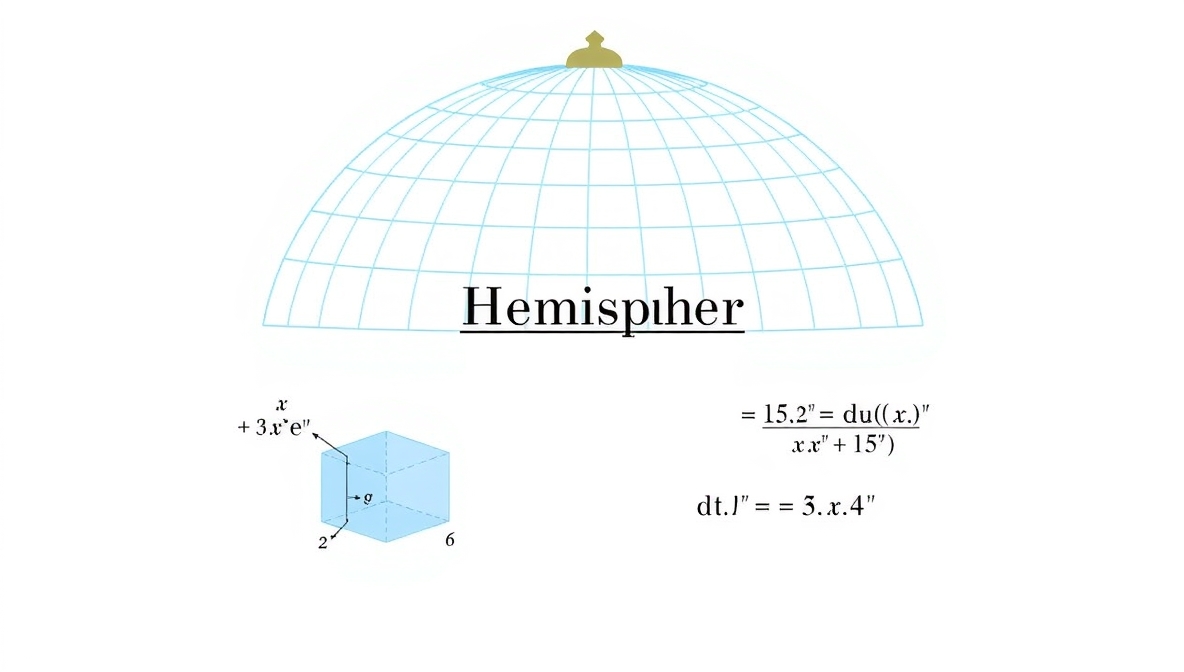
The Volume of a Hemisphere is a very interesting topic that helps us understand how much space is inside half of a sphere. When we talk about the volume of a hemisphere, we mean finding how much space is filled in a 3D half-ball shape. This topic is fun because it connects to so many things around us like bowls, domes, scoops, and even the top half of the Earth. In simple words, a hemisphere is half of a sphere, and learning about its volume helps us measure real objects easily. The concept may sound a little hard at first, but with easy examples and clear steps, anyone can learn it, even small kids who love to explore math in a fun way. Understanding the volume of a hemisphere also builds a strong base for learning about other 3D shapes such as cylinders, cones, and spheres.
When we study the volume of a hemisphere, we are learning how to measure space inside something that is round and curved. The formula we use comes from the formula for a full sphere, but since a hemisphere is half of it, we divide by two. The main formula for the volume of a sphere is (4/3)πr³, so for a hemisphere, we take half of that: (2/3)πr³. Here “r” means the radius, which is the distance from the center of the sphere to its edge. The formula might look a bit tricky, but once you understand what each part means, it becomes super easy. Think of a scoop of ice cream or a dome on a building — both are great real-world shapes that match a hemisphere. If you want to know how much space they take up, this formula helps. In math and science, we often need to find the volume of a hemisphere when solving problems about liquids, containers, or even the shape of planets. It shows how important and useful this simple idea is in our everyday lives.
Easy Formula to Calculate the Volume of a Hemisphere Step by Step
To find the volume of a hemisphere, we use a very easy formula. The formula is (2/3)πr³. Here, “r” means the radius, which is the distance from the center to the edge of the circle. The π (pi) is about 3.1416 and helps with round shapes. You just multiply 2, divide by 3, multiply by π, and then multiply by the radius three times (r × r × r). Once you do this, you get the total volume. It’s a simple way to know how much space is inside half a ball. Practice a few examples, and you’ll remember it easily!
How Radius Affects the Volume of a Hemisphere
The radius plays a big role in finding the volume of a hemisphere. If the radius is small, the volume will also be small. But if the radius gets bigger, the volume grows a lot more. That’s because the radius is cubed (r³) in the formula, meaning even small changes make a big difference. So, doubling the radius makes the volume grow by eight times! This shows how powerful the radius is in shaping size. It’s like when you blow air into a balloon — the bigger it gets, the more space it takes up inside. Radius decides how roomy your hemisphere will be!
Real-Life Examples of Volume of a Hemisphere for Kids and Beginners
You can see hemispheres everywhere around you! A bowl, a scoop of ice cream, a dome roof, or even half an orange are all shaped like hemispheres. When you know how to find their volume, you can tell how much they hold or cover. For example, an ice cream maker can calculate how much ice cream fits in a scoop. Builders use this idea when making domes or tanks. Even scientists use it to measure the top half of planets or bubbles. So, learning about the volume of a hemisphere isn’t just math — it’s a skill that connects numbers with the real world!
Fun Way to Learn Volume of a Hemisphere Using Everyday Objects
Learning about the volume of a hemisphere can be super fun when you use real things. Take a round ball and cut it in half, or use a small bowl. Fill it with rice or water and see how much it can hold — that’s its volume! You can try using playdough or clay to make your own hemispheres and measure them. Doing this helps you see how the formula works in real life. It’s an easy way to learn by touching, seeing, and trying. Math becomes exciting when you use your hands and imagination together!
Common Mistakes to Avoid When Finding the Volume of a Hemisphere
When calculating the volume of a hemisphere, many people make small mistakes. One common error is forgetting to divide the sphere’s formula by two. Remember, a hemisphere is half of a sphere! Another mistake is mixing up diameter and radius. The formula needs the radius only, not the diameter. Some students also forget to cube the radius (r³), which changes the answer completely. Always write the formula clearly and double-check each step. Taking your time and reviewing your work helps avoid errors. Once you get used to it, you’ll find it very simple and quick to do!
Why Learning Volume of a Hemisphere Is Useful in Daily Life
Learning the volume of a hemisphere helps you understand how much space round things take up. It’s used in so many real-life situations! Cooks use it to measure bowls, engineers use it to design domes, and scientists use it to study planets. It even helps in art and design when creating curved objects. Knowing this concept makes you smarter in both math and everyday life. You’ll be able to guess and measure things easily, like how much water fills a bowl or how big a scoop can be. Math becomes practical and fun when you learn it this way!
Volume of a Hemisphere vs. Volume of a Sphere: What’s the Difference?
The main difference between a hemisphere and a sphere is that a hemisphere is half of a sphere. A sphere is a full 3D ball shape, and its volume formula is (4/3)πr³. But a hemisphere only has half of that space, so its formula becomes (2/3)πr³. The hemisphere also has one flat circular base, while a sphere is curved all around. This makes the hemisphere easier to use in daily life, like for bowls or domes. So, if you can find the volume of a sphere, finding the volume of a hemisphere is just half as easy!
Easy Practice Tips to Remember the Volume of a Hemisphere Formula
To remember the volume of a hemisphere formula easily, think of it as “half a sphere.” The full sphere’s formula is (4/3)πr³, so just take half — that’s (2/3)πr³. You can make a fun rhyme like “Two by three and pi r cube, helps you find the space inside a tube!” Writing the formula again and again also helps your memory. You can even draw pictures of a sphere and cut it in half. The more you practice, the faster you’ll remember it. Learning by doing and repeating makes math simple and fun!
Conclusion
The volume of a hemisphere is one of the most interesting topics in math. It teaches you how to measure space inside half of a ball and helps you understand shapes better. Once you know the simple formula (2/3)πr³, you can use it anywhere — from schoolwork to real-life situations. Learning this topic builds curiosity and makes you see how math is part of everything around you. The more you practice, the easier it becomes to calculate and imagine 3D shapes. So keep exploring, keep measuring, and enjoy learning about the volume of a hemisphere — it’s easy, useful, and full of fun for young learners like you!
FAQs
Q1: What is the formula for the volume of a hemisphere?
The formula is (2/3)πr³, where “r” is the radius of the hemisphere.
Q2: Why do we divide by 2 in the hemisphere formula?
Because a hemisphere is half of a sphere, so we divide the sphere’s volume by two.
Q3: What is the difference between a sphere and a hemisphere?
A sphere is a full ball, while a hemisphere is just half of it with one flat side.